
张闯在Frontiers in Microbiology发表关于13年增温和氮添加的协同作用加剧华北平原农田土壤碳库不稳定性的研究成果
土壤存储着陆地生态系统约2/3的碳,因此土壤碳库的稳定性对缓冲气候变化起到关键作用。尽管长期增温导致全球尺度上碳库下降,但其优先消耗土壤易分解碳库还是稳定碳库仍存在争议。华北平原是我国主要粮仓之一,农田生态系统氮肥管理为土壤微生物提供养分,而氮添加与长期增温对土壤碳库稳定性是否存在交互作用仍不明确。
本研究依托中国科学院栾城生态试验站长期野外红外辐射增温和氮添加连续试验,通过室内为期120天的秸秆添加微宇宙培养试验,利用碳库分解模型和同位素分馏原理,分析了土壤碳库组成,秸秆碳在微生物生物量碳、呼吸的分馏系数,量化了秸秆添加造成的激发效应,探讨了全球持续变暖下氮肥管理农田土壤碳库组成响应规律,以及微生物对外源碳输入的响应特征。
结果表明,13年增温、氮添加、增温与氮添加交互处理均未明显改变土壤有机碳库含量。但相比于对照处理,三者均显著导致速效碳库和稳定碳库下降,而使复杂碳库含量提升。且长期增温与氮添加交互处理中土壤稳定碳库下降幅度显著高于增温、氮添加单一处理。秸秆添加培养试验中,增温处理土壤微生物量在培养第3天达到最大,且其δ13C-MBC值在培养的120天内与对照处理相近;增温与氮添加交互处理土壤微生物量在培养的第14天、30天和120天均显著高于增温、氮添加和对照处理,且其δ13C-MBC值在培养的第3天、14天、30天和120天均低于对照处理。仅增温处理中秸秆添加造成的激发效应高于对照,而增温与氮添加交互处理中秸秆添加造成的激发效应低于对照。
本研究表明,长期增温和氮添加的交互作用加速了土壤稳定碳库向复杂碳库的转变,增加了土壤碳库的不稳定性。对于外源碳的利用,长期增温处理土壤微生物倾向用于能量代谢,而增温和氮添加的交互处理土壤微生物倾向用于生殖代谢。本研究表明未来全球持续变暖下氮肥管理的农田土壤遭受潜在胁迫的风险更高。
该成果近期发表于Frontiers in Microbiology,第一作者为河南省科学院地理研究所张闯助理研究员,通讯作者为中国科学院遗传与发育生物学研究所农业资源研究中心董文旭研究员。
该研究得到河南省科学院科研启动经费项目(241801042)、河南省科技研发计划联合基金重点项目(225200810008)、河北省自然科学基金(C2024404001)、河北省教育厅科学研究项目(2025QNJS03)和河南省科学院智库项目(20260701003)等项目的共同支持。
论文信息:
Zhang C, Dong W, Wang J, Li W, Zhang R, Li X, Liu X, Yang Y, Zhang Y and Hu C (2026) Synergistic effects of 13-year warming and nitrogen fertilization accelerating soil carbon destabilization in North China Plain farmland. Front. Microbiol. 17:1775179. doi: 10.3389/fmicb.2026.1775179
论文链接:
https://doi.org/10.3389/fmicb.2026.1775179
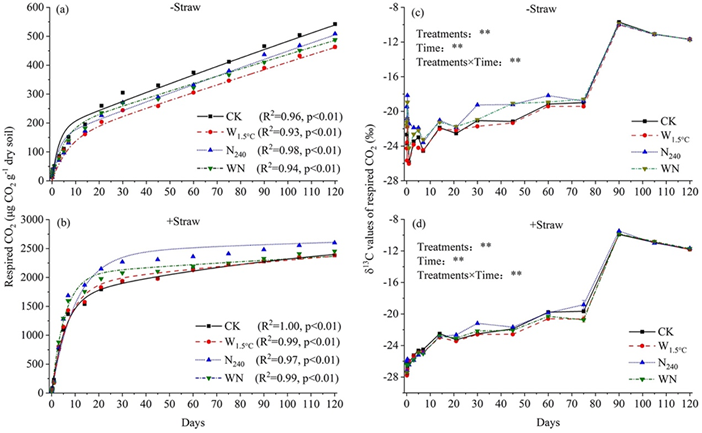
FIGURE 1 Dynamics of respired CO 2 and δ13 C-CO 2 values in soils subjected to 15 years of warming and nitrogen fertilization, with air (a,c) and straw (b,d) amendments. Curved lines represent fits to a three-carbon-pool model based on a first-order kinetic equation.
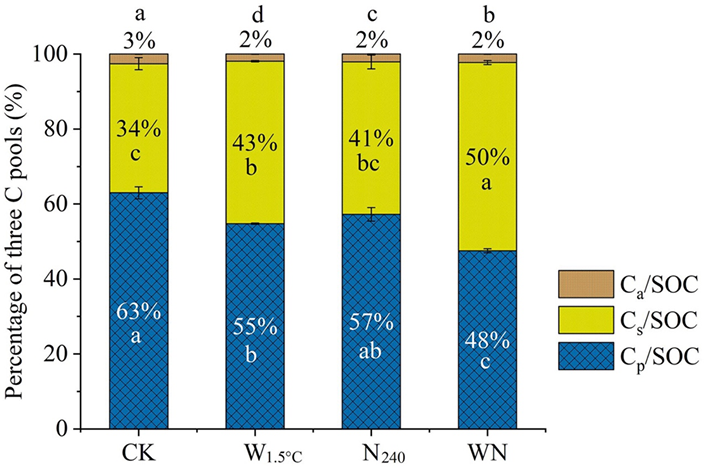
FIGURE 2 Relative contributions of three carbon pools to total soil organic carbon in soils exposed to 15 years of warming and nitrogen fertilization. Lowercase letters indicate statistically significant differences between treatment groups (n = 3, p < 0.05).
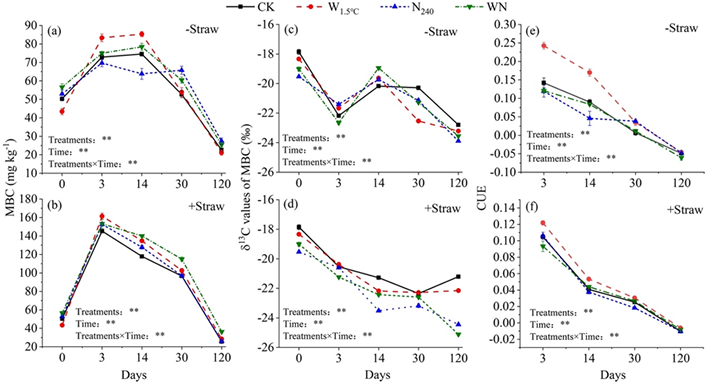
FIGURE 3 Temporal dynamics of microbial biomass carbon (MBC), corresponding δ13 C-MBC values, and microbial carbon use efficiency (CUE) in response to air (a,c,e) and straw (b,d,f) amendments in soils subjected to 15 years of warming and nitrogen fertilization.
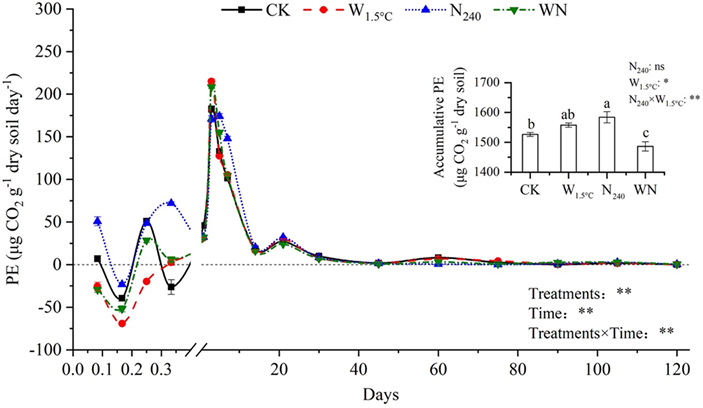
FIGURE 4 Priming effects (PEs) mediated by 15 years of warming and nitrogen fertilization during incubation. Lowercase letters denote statistically significant differences between treatments (n = 3, p < 0.05).
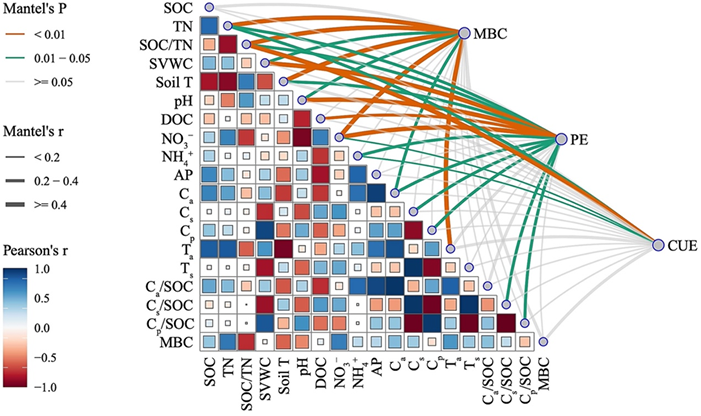
FIGURE 5 Mantel test and Pearson correlation analyses exploring the relationships between priming effects (PE), microbial biomass carbon (MBC), and microbial carbon use efficiency (CUE) induced by straw additions and ambient soil physicochemical properties (n = 12). Line color and size represent the p and r values of the Mantel test, respectively. Square color and size depict the p and r values of Pearson correlation analysis, respectively.
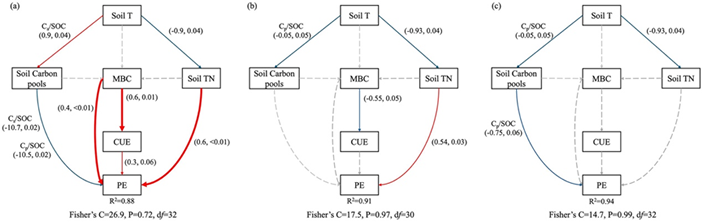
FIGURE 6 The direct and indirect interactions among ambient soil carbon pools, nutrient contents, initial microbial biomass, and CUE on priming effects (PEs) were elucidated using structural equation models (SEMs) across three distinct incubation periods: (a) The initial 2 h, (b) up to 14 days, and (c) 30 days (n = 12). Soil T and TN represent soil temperature and total nitrogen content at a depth of 10 cm, respectively. Ca /SOC, Cs /SOC, and Cp /SOC denote the ratios of labile, stable, and passive carbon pool sizes to total soil organic carbon. MBC and CUE represent initial microbial biomass carbon and carbon use efficiency. Blue solid lines denote significant negative effects, and red solid lines signify significant positive correlations (p < 0.05). Gray dotted lines denote the lack of significant correlations (p > 0.05).
撰稿:张 闯
初审:任 杰
复审:杜 军
终审:鲁 鹏