
张闯在Agronomy发表关于水肥共同限制调控农田土壤微生物群落和酶活性对13年增温响应的研究成果
土壤酶直接参与有机质分解,主要来源于土壤微生物。因此土壤酶的分配策略代表了微生物的养分需求,同时也是微生物驱动土壤有机质分解,影响碳排放的关键因素。尽管全球尺度,土壤碳排放随着增温年限变长而逐年下降,但是长期增温下微生物群落组成的变化规律,以及酶的分配策略仍存在争议。明确调控土壤微生物调控酶合成的关键因素,将直接服务于我国双碳目标。
本研究依托中国科学院栾城生态试验站长期野外红外辐射增温连续试验,通过采集试验第九年土壤样品和野外土壤碳排放数据,利用磷脂脂肪酸提取(PLFA)分析了微生物群落生物量和群落组成;通过测定碳、氮和磷分解相关水解酶和氧化酶活性,分析了酶的分配策略。探讨了九年连续增温下土壤微生物群落和酶活性的响应特征。
结果表明,九年增温使微生物群落生物量(总PLFA)下降45%,但提升了冬小麦生长季(5月份)革兰氏阳性菌于革兰氏阴性菌生物量的比值,以及提升了撂荒季(8月份)真菌于细菌生物量的比值。革兰氏阳性菌和真菌能够利用木质素、多酚类化合物等复杂碳源。因此可见,九年增温使得微生物群落向利用复杂碳源的群落组成转移。尽管九年增温未明显改变参与木质素、多酚类化合物等复杂碳源分解相关的氧化酶活性,但显著提升了单位微生物量的氧化酶活性。同时长期增温也显著提升了冬小麦生长季和撂荒季碳、氮和磷分解相关的水解酶活性。
本研究表明,九年增温下土壤微生物群落向利用木质素等复杂碳源方向转移,土壤全氮含量的下降时驱动微生物群落转移的主要动力。本研究表明土壤养分比例失衡时限制土壤微生物群落生物量的主要因素。但利用复杂碳源的微生物群落相对丰度提升,也意味着未来全球持续变暖下华北平原农田土壤碳损失的风险提升。
该成果近期发表于Agronomy,第一作者为河南省科学院地理研究所张闯助理研究员,通讯作者为中国科学院遗传与发育生物学研究所农业资源研究中心董文旭研究员。
该研究得到河南省科技研发计划联合基金重点项目(225200810008)、河南省科学院科研启动经费项目(241801042)和河南省科学院智库项目(20260701003)等项目的共同支持。
论文信息:
Zhang, C., Dong, W., Wang, J., Manevski, K., Timilsina, A., & Hu, C. (2026). Water–Nutrient Co-Limitation Governed Farmland Soil Microbial Community and Enzymatic Responses to Nine-Year Warming. Agronomy, 16(5), 535. https://doi.org/10.3390/agronomy16050535
论文链接:
https://doi.org/10.3390/agronomy16050535
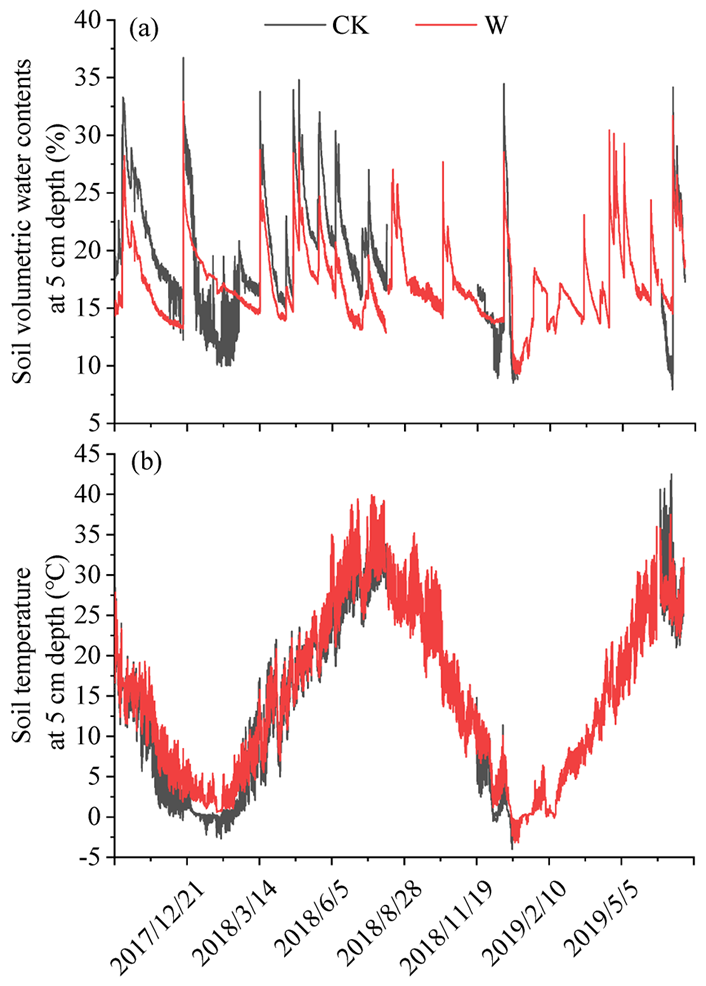
Figure 1. Effect of long-term warming on (a) soil volumetric water contents and (b) temperature at 5 cm depth between 2017 and 2019.
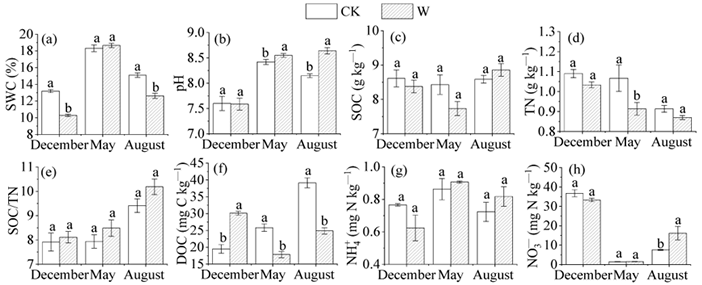
Figure 2. Seasonal dynamics of soil properties in response to long-term warming. (a) SWC is soil water content, (b) pH denotes soil acidity, (c) SOC is soil organic carbon, (d) TN is total soil nitrogen, (e) SOC/TN is the ratio of SOC to TN, (f) DOC is soil dissolved carbon, and (g) NH4+ and (h) NO3− are, respectively, soil ammonium and nitrate. Bars with different letters per sampling time are significantly different of each other (p < 0.05).

Figure 3. Seasonal dynamics of (a) bacteria, (b) the ratio of GP to GN, (c) fungi, (d) the ratio of bacteria to fungi, and (e) total biomass in response to long-term warming. GP and GN indicate Gram-positive and Gram-negative bacteria, respectively; AMF and SAP are, respectively, arbuscular mycorrhizal and saprophytic fungi. Bars with different small letters per variable (GP, GN, AMF, SAP, and actinomycetes) and sampling time are significantly different from each other (p < 0.05); Stacked bars with different capital letters per sampling time are significantly different (p < 0.05).
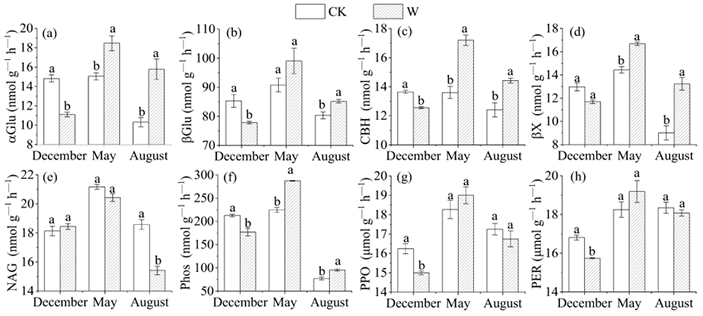
Figure 4. Seasonal dynamics of soil enzyme absolute activities in response to long-term warming. (a) αGlu is α-1,4-glucosidase, (b) βGlu is β-1,4-glucosidase, (c) CBH is cellobiohydrolase, (d) βX is β-1,4-xylosidase, (e) NAG is β-1,4-N-acetylglucosaminidase, (f) Phos is alkaline phosphatase, (g) PPO is phenol oxidase, and (h) PER is peroxidase. Bars with different letters per sampling time are significantly different (p < 0.05).
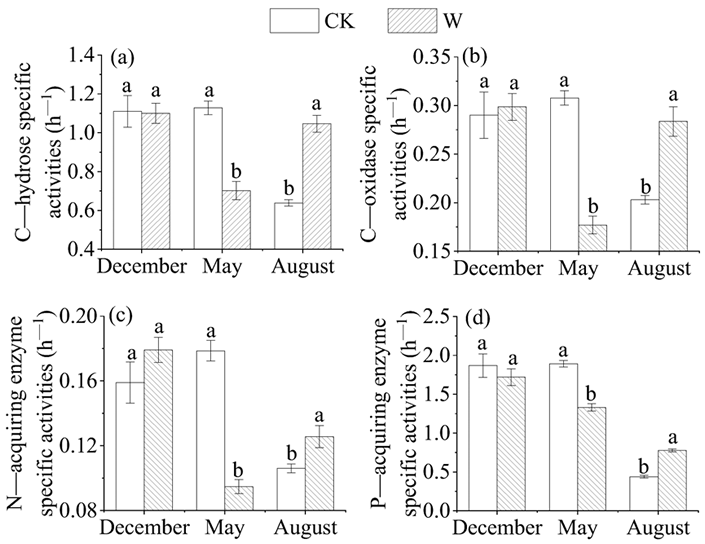
Figure 5. Seasonal dynamics of soil-specific activities of (a) C-, (c) N-, and (d) P-hydrolase and (b) oxidase in response to long-term warming. Bars with different letters per sampling time are significantly different (p < 0.05).
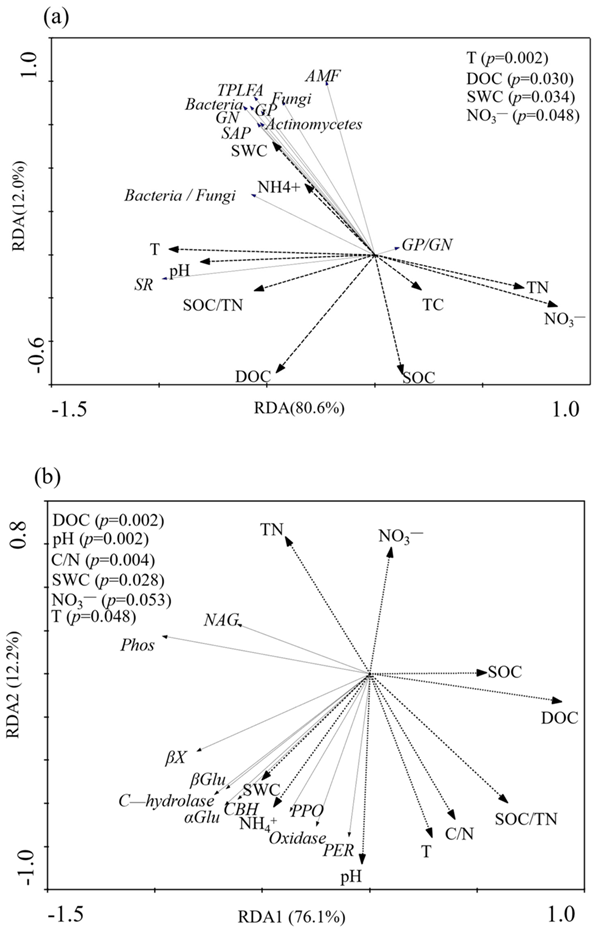
Figure 6. Redundancy analysis among soil physico-chemical and microbial properties (a) and enzyme absolute activities (b). T is soil temperature at a 5 cm depth; SR is soil respiration; TC is soil total carbon; C hydrolase is the sum of αGlu, βGlu, CBH and βX; and oxidase is the sum of PPO and PER. The other abbreviations are the same as those in Figure 2, Figure 3 and Figure 4.
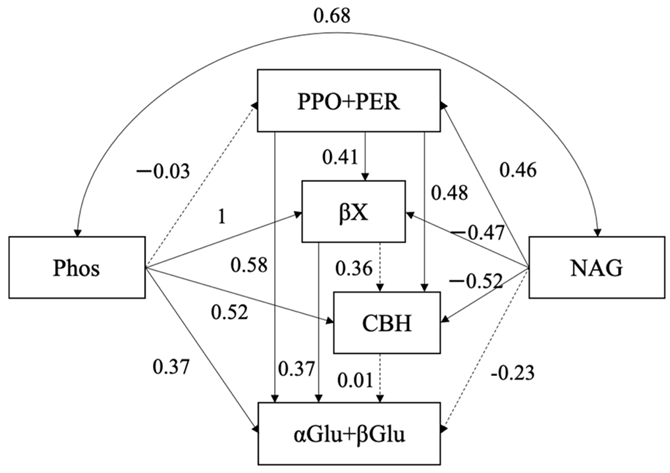
Figure 7. Structural equation model of the influence of NAG, Phos and oxidase absolute activities on C-hydrolases targeting different organic C compounds. Values close to the arrows are standardized path coefficients. Solid lines represent significant correlations (p < 0.05), the dashed lines represent insignificant correlations (p > 0.05). Abbreviations are the same as those in Figure 4.
撰稿:张 闯
初审:任 杰
复审:杜 军
终审:鲁 鹏